

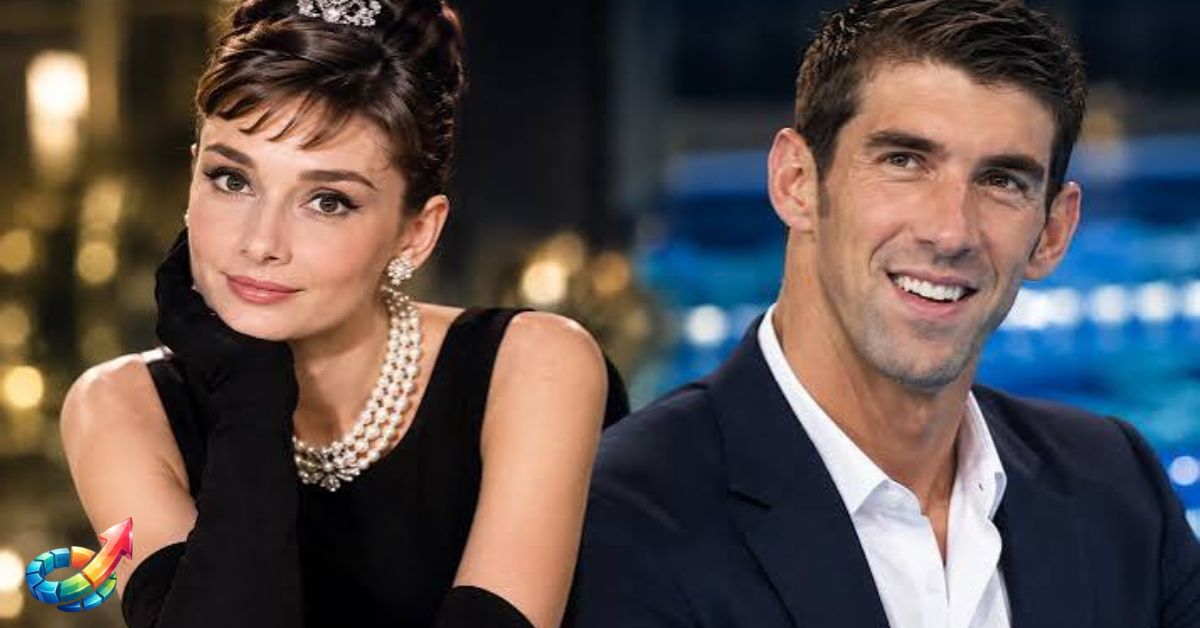
Michael Phelps and Audrey Hepburn belong to different worlds, yet both reshaped their fields. Audrey Hepburn, a British actress and humanitarian, brought quiet elegance to Hollywood cinema and later gave her final years to UNICEF. Michael Phelps, an American Olympic swimmer, rewrote Olympic swimming history with 28 Olympic medals, making him the most decorated Olympian in history.
Both overcame early hardship. Hepburn survived World War II in the occupied Netherlands, while Phelps learned to channel childhood energy into the pool. Their biographies, awards, charity work, families, and lasting influence show how two very different careers can leave similar marks on the world.
Quick Facts: Audrey Hepburn and Michael Phelps Side by Side
| Detail | Audrey Hepburn | Michael Phelps |
| Full Name | Audrey Kathleen Ruston (later Hepburn) | Michael Fred Phelps II |
| Born | May 4, 1929 | June 30, 1985 |
| Died | January 20, 1993 | Still living |
| Birthplace | Ixelles, Brussels, Belgium | Baltimore, Maryland, USA |
| Nationality | British | American |
| Profession | Actress, humanitarian | Olympic swimmer |
| Height | 5’7″ (170 cm) | 6’4″ (193 cm) |
| Spouse(s) | Mel Ferrer, Andrea Dotti | Nicole Johnson |
| Children | Sean Hepburn Ferrer, Luca Dotti | Four sons |
| Nickname | Just “Audrey” to most fans | “The Flying Fish,” “The Baltimore Bullet” |
Early Life
Both icons were shaped by their families and by pressure from an early age. Audrey Kathleen Ruston was born in Ixelles, Brussels, to a British father and a Dutch mother. Michael Fred Phelps II grew up in Baltimore, Maryland, in a household built around school, sport, and a mother’s steady support. Their childhoods looked nothing alike, but each gave them the discipline that later defined their careers.
Audrey Hepburn’s Childhood Was Shaped by War
Audrey Hepburn’s childhood was unsettled from the start. Her father left the family when she was young, and her mother, Ella van Heemstra, a Dutch baroness, raised her largely alone. When World War II began, the family settled in the Netherlands, expecting safety. Instead, they lived under German occupation in Arnhem.
Food grew scarce during the final winter of the war, and Hepburn suffered from malnutrition. She also performed secret dance recitals to raise money for the Dutch resistance, an experience she spoke about for the rest of her life.
After the war, she pursued ballet training in Amsterdam under Sonia Gaskell and later in London under Marie Rambert. Rambert reportedly told her that her height and wartime health made a top ballerina career unlikely. Hepburn gave up the idea of becoming a professional dancer and moved toward acting, but her dance background shaped her graceful screen movement.
Michael Phelps Started Swimming to Burn Off Energy
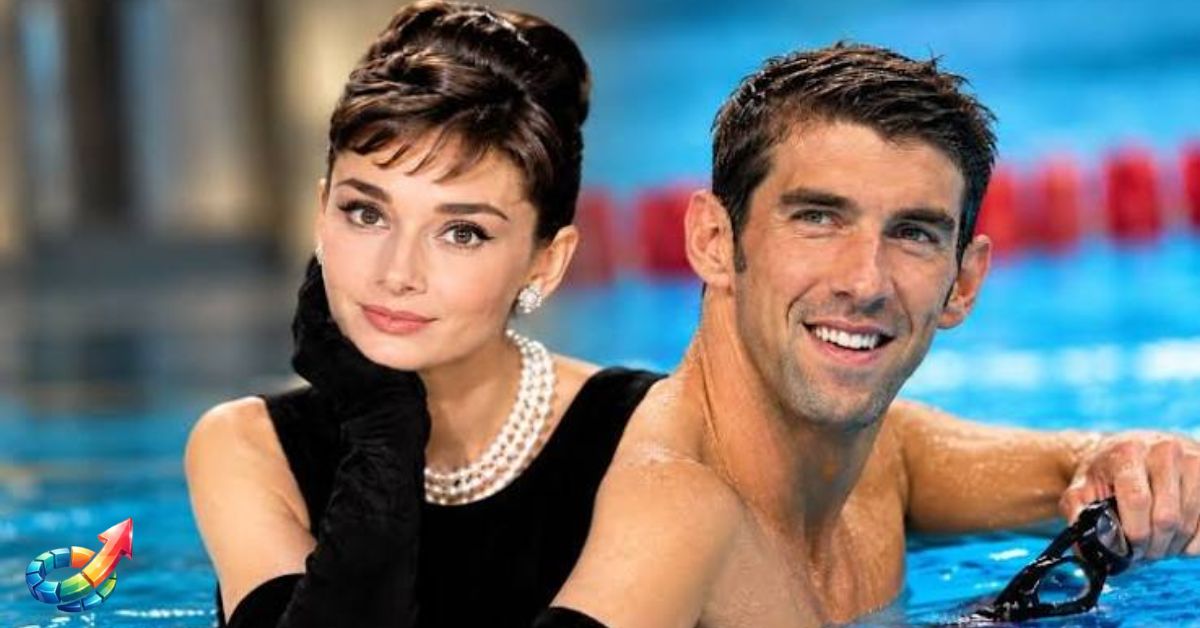
Michael Phelps’ childhood centered on the pool. He grew up with his parents, Fred Phelps and Debbie Phelps, and his older sisters, Hilary Phelps and Whitney Phelps, who both swam competitively. Michael followed them into the water. Swimming also gave him a healthy outlet for his energy. He was diagnosed with ADHD in elementary school, and the structure of training helped him focus.
Coach Bob Bowman recognized his talent early. Phelps trained relentlessly and qualified for the Sydney 2000 Olympics at just 15, becoming the youngest male on the US swim team in 68 years. He finished fifth in the 200-meter butterfly, an early sign of what was coming. His mother, Debbie Phelps, remained a visible source of support throughout his career.
Rise to Fame
Both stars rose quickly once their big moment arrived. Hepburn needed one film to become a household name, while Phelps needed one Olympic cycle to turn from promising teenager into a global headline. Their paths show how preparation and opportunity can meet at the right moment.
Audrey Hepburn Won an Oscar for Her First Major Hollywood Role
After small stage and film roles in Europe, Hepburn was cast in Roman Holiday in 1953 as a princess who escapes royal duties for a day in Rome. Her co-star was Gregory Peck, already a major Hollywood leading man, who insisted she share top billing once he saw her talent. Her performance earned the Academy Award for Best Actress, a remarkable result for a first major Hollywood role.
Michael Phelps Turned the Beijing Olympics Into History
Phelps first won big at Athens 2004, where he took six gold medals and two bronze medals. Four years later, the Beijing 2008 Olympics made him a legend. He won eight gold medals at Beijing 2008, breaking Mark Spitz’s single-Games record of seven, which had stood since 1972. Seven of those wins came in world-record time.
His margin in the 100-meter butterfly was one-hundredth of a second, a finish that still ranks among the most famous in Olympic swimming history. That Games established Olympic athletic dominance on a scale no swimmer had shown before.
Major Achievements and Awards
The awards each icon collected reflect the scale of their work. Hepburn’s honors came from across entertainment, while Phelps’s came almost entirely from one arena, the Olympic pool, repeated over five Games.
Audrey Hepburn Collected Nearly Every Major Entertainment Honor
Hepburn’s career produced a rare range of awards. The main ones include:
- Academy Award for Best Actress for Roman Holiday
- BAFTA Award wins for her screen work
- Golden Globe Award recognition
- Tony Award for Ondine
- Posthumous Emmy Award for her documentary series about the world’s gardens
- Posthumous Grammy Award for a spoken-word children’s album
Those last two wins make her an EGOT winner, meaning she earned an Emmy, Grammy, Oscar, and Tony. Among her best-known later films are Breakfast at Tiffany’s (1961), in which she played Holly Golightly, Charade (1963), and My Fair Lady (1964).
Michael Phelps Holds the Record for Most Olympic Medals Ever
| Games | Gold | Silver | Bronze |
| Athens 2004 | 6 | 0 | 2 |
| Beijing 2008 | 8 | 0 | 0 |
| London 2012 | 4 | 2 | 0 |
| Rio 2016 | 5 | 1 | 0 |
Humanitarian Work and Legacy Beyond Their Field
Both icons used their fame for causes beyond entertainment and sport. Their motives differed. Hepburn drew on her wartime memories, while Phelps drew on his own painful struggles, but each tried to help people who were vulnerable.
Audrey Hepburn Spent Her Final Years Helping Children in Crisis
Hepburn had received food aid as a child in the Netherlands, and she never forgot it. In 1988 she became a UNICEF Goodwill Ambassador and devoted her final years to humanitarian work focused on child hunger and children in crisis. She traveled to Ethiopia, Sudan, Somalia, Bangladesh, and Vietnam, among other places, drawing global attention to children’s needs.
In December 1992, only weeks before her death, she was awarded the Presidential Medal of Freedom, the highest civilian honor in the United States. She died on January 20, 1993, in Tolochenaz, Switzerland. Audrey Hepburn’s cause of death was appendix cancer.
Michael Phelps Now Champions Water Safety and Mental Health
After his swimming career, Phelps turned to two causes. The Michael Phelps Foundation promotes water safety and drowning prevention, teaching children to swim and stay safe around water.
He also became a leading voice for mental health awareness. He has spoken openly about depression among elite athletes and about moments when he struggled badly after major competitions. His story is told in The Weight of Gold, an HBO documentary released in 2020 that examines the emotional toll of Olympic life. Many fans say his honesty helped normalize conversations about therapy in sport.
Personal Life
Their private lives were also very different. Hepburn’s story is one of romance, loss, and a longing for stability. Phelps’s is one of public mistakes followed by repair and family growth. Each reminds readers that fame does not guarantee an easy personal life.
Audrey Hepburn Found Love Twice But Struggled with Marriage
Hepburn married actor Mel Ferrer in 1954, and they had a son, Sean Hepburn Ferrer. The marriage ended in 1968. She then married Italian psychiatrist Andrea Dotti, and they had a son, Luca Dotti. That marriage also ended, in 1982.
She later found lasting happiness with Dutch actor Robert Wolders, her companion for the last years of her life. Hepburn often said that her sons mattered more to her than her film career, and she stepped back from acting to raise them.
Michael Phelps Built a Family After Years of Public Struggles
Phelps faced serious personal struggles during his career. A DUI arrest in 2014 was a turning point. He entered a treatment program, stepped back from competition, and later credited therapy and family support with saving him.
He reportedly married Nicole Johnson, a former Miss California, in a private ceremony in June 2016, around the time he was preparing for Rio. Today the couple raise four sons. Marriage and family life became the center of his world, and he often says fatherhood changed his sense of purpose.
Style, Image, and Cultural Influence
Image mattered to both icons, though in different ways. Hepburn’s image was deliberately crafted and became part of film history. Phelps’s was built on what his body and results could do, and it turned him into a face of sport.
Audrey Hepburn Redefined What Fashion Icon Meant
Hepburn’s partnership with designer Hubert de Givenchy shaped modern fashion. The French couturier dressed her in Sabrina, and their Givenchy fashion partnership continued for decades. The black dress she wore as Holly Golightly turned the little black dress into a wardrobe staple.
Her look was simple: clean lines, ballet flats, bold brows, and a graceful neck. This style countered older ideas of Hollywood glamour and set a new standard. Her cinema fashion influence still appears on runways and in costume design.
Michael Phelps Became the Face of Modern Competitive Swimming
Phelps’s image was tied to performance. His long arms, large feet, and flexible joints made him a natural in the water, and his swimming race strategy, built on strong underwater kicks and relentless finishing speed, changed how swimmers train. His “Flying Fish” and “Baltimore Bullet” nicknames became part of sports culture.
He brought swimming a level of attention it had rarely received between Olympic years. His popularity pushed sponsors, broadcasters, and young athletes toward the sport. After retirement, he worked as an NBC Olympic broadcast analyst, sharing his expertise with a new generation of viewers.
Side-by-Side Comparison: Hepburn vs Phelps
| Category | Audrey Hepburn | Michael Phelps |
| Field | Hollywood cinema and humanitarian work | Olympic swimming |
| Peak Years | 1953 to 1960s | 2004 to 2016 |
| Top Honor | Academy Award for Best Actress | 23 Olympic gold medals |
| Defining Moment | Roman Holiday in 1953 | Eight golds at Beijing 2008 |
| Charity Focus | UNICEF, child hunger | Water safety, mental health |
| Signature Image | Little black dress, Givenchy | Goggles, wingspan, Team USA cap |
| Documentary | Audrey (2020) | The Weight of Gold (2020) |
Influence and Legacy Today
Decades after their peaks, both remain reference points. Hepburn’s influence lives in style, film, and charity, while Phelps’s influence lives in records, training methods, and open conversations about mental health.
Audrey Hepburn’s Style Still Shapes Fashion Decades Later
Audrey Hepburn’s lasting influence appears in modern wardrobes, bridal looks, and film retrospectives. Breakfast at Tiffany’s remains her most famous movie, and her image still appears on posters, books, and exhibitions. Her classic Hollywood style is regularly cited by designers as proof that restraint can be powerful.
Michael Phelps Remains the Standard Every Swimmer Chases
Michael Phelps’s Olympic legacy is measured against every new swimming star. Whenever a swimmer wins several golds at one Games, comparisons to Beijing 2008 follow. He retired after Rio 2016 and does not compete today, though he stays involved in the sport through broadcasting and his foundation.
Lessons From Both Icons
These two stories offer practical lessons that go beyond fame. The following points sum up what both careers show.
- Early hardship can build resilience when it is met with support and effort.
- Daily discipline, such as ballet practice or pool training, turns talent into results.
- Asking for help is a strength, as Phelps’s recovery showed.
- Public attention is most valuable when it serves other people.
Read More: Sam Brock Height, Age, Wife & NBC Career 2026
Hardship Early in Life Shaped Both of Their Futures
Hepburn’s war-torn childhood gave her a deep empathy for hungry children. Phelps’s early restlessness taught him how structure and coaching could change a life. In both cases, hardship and resilience became the base for later success rather than an obstacle to it.
Read More: Angelina Jolie and Tom Brady Dating? The Real Story 2026
Using Fame for Something Bigger Than Themselves
Hepburn turned fame into public service for children, and Phelps turned his into support for water safety and mental health awareness. Their fame and public service show that celebrity can become a tool for change when it is used with purpose.
Read More: Jay Cinco age in 2026: birthday, real name, biography & untold story
Frequently Asked Questions
What is Audrey Hepburn’s most famous movie?
Breakfast at Tiffany’s (1961) is usually considered her most famous movie, thanks to her portrayal of Holly Golightly and the iconic little black dress. Roman Holiday is her most decorated, since it earned her the Academy Award for Best Actress.
How many Olympic medals does Michael Phelps have?
Michael Phelps has 28 Olympic medals: 23 gold, 3 silver, and 2 bronze. This is the highest total of any Olympian in history.
Did Audrey Hepburn and Michael Phelps ever meet?
There is no record that they met. Hepburn died in 1993, when Phelps was only seven years old and had not yet begun his Olympic career.
What was Audrey Hepburn’s cause of death?
Audrey Hepburn died of appendix cancer on January 20, 1993, at her home in Tolochenaz, Switzerland, at age 63.
Does Michael Phelps still compete in swimming?
No. Michael Phelps retired from competitive swimming after the Rio 2016 Olympics. He now works as a broadcast analyst, advocate, and foundation leader.
Conclusion
Audrey Hepburn and Michael Phelps came from different centuries, countries, and professions, but their stories share a clear shape: early challenge, disciplined work, historic achievement, and a later commitment to helping others. Hepburn gave film audiences grace and gave children in crisis a voice. Phelps gave swimming its greatest record and gave athletes a more honest way to talk about mental health. Their legacies prove that true greatness is measured by impact as much as by awards.
